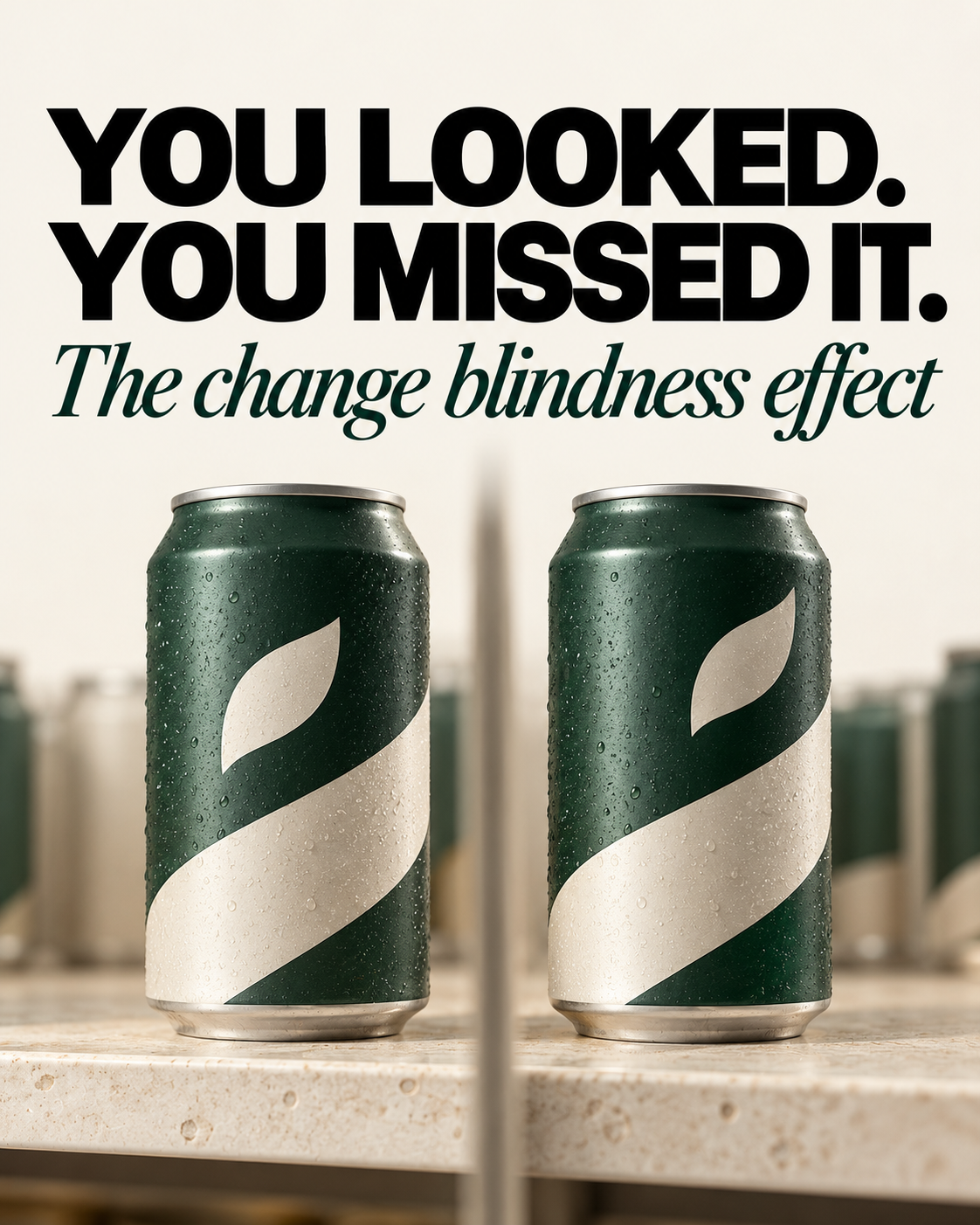
Carlos, you can look directly at someone while that person is replaced by a stranger, and still miss the switch.
1. What happened
In a 1998 study, psychologists Daniel Simons and Daniel Levin had an experimenter stop pedestrians to ask for directions. As the conversation continued, workers carried a door between them. Behind the door, a different experimenter took the first person's place and continued talking. Only about half of the pedestrians detected the substitution. This small study does not establish a universal detection rate.
The phenomenon is called change blindness. It is not blindness to the person. It is a failure to register that something has changed across two moments.
2. The mechanism
To detect change, we must encode relevant details from the first scene and compare them with the second. Attention determines which features enter that comparison.
Usually a sudden movement or brief visual disturbance points toward the location of a change. But a passing door, an eye movement, or a blank interval can disrupt that local signal.
In a famous 1997 experiment, Ronald Rensink, J. Kevin O'Regan, and James Clark alternated a photograph with a modified version, inserting a brief blank between them. Even sizeable repeated changes could remain difficult to locate. Once observers were directed toward the relevant object, detection improved substantially.
We can retain a scene's basic meaning, like "I'm discussing directions," without retaining enough detail to detect a replacement. This does not prove the brain stores no visual detail.
Boundary condition: Not every big change goes unnoticed. Detection depends on attention, salience, interruption, expectations, and the task. Looking and noticing are different, not unrelated.
3. Outside CPG, the lesson is uncomfortable
The pedestrian study occurred during a live conversation. Even interaction does not guarantee noticing.
An inner-life implication needs care: someone missing a change in you does not necessarily mean they do not care. But after a change is pointed out, attention becomes a responsibility. Perception and response are different questions.
4. What it changes in CPG
Imagine a hypothetical beverage redesign. The current can is dark green. The new can has a new visual architecture, slightly lighter color, and a refined wordmark. In the presentation, the differences look huge because both options sit side by side.
A shopper sees only the new can, in a crowded cooler, with seconds to decide.
Will they recognize the brand? Find the right flavor? Understand the product? Notice the redesign? Those are four different outcomes.
A "spot the difference" test measures change detection. A shelf-finding task measures findability. A comprehension test examines what the pack communicates. None automatically proves sales impact.
5. Challenge the assumption
"If a redesign looks dramatic in a deck, shoppers will notice it."
Maybe. But comparison slides practically tell the viewer where to look. Real shopping usually does not.
Counterargument: not every useful update needs to look new. Better navigation with familiar cues may beat a dramatic redesign that attracts attention but hurts recognition.
The correct test depends on the decision, not on what creates the most impressive before-and-after slide.
6. Your mental operator
Ask: What must someone attend to, remember, and compare for my claimed improvement to become visible? Then ask whether your test recreates those conditions.
7. Reasoning exercise
A team tests a can redesign with 80 shoppers. After an interrupted before-and-after sequence, 12 correctly identify what changed. The team concludes that the new packaging will fail at retail.
Before reading the answer, decide: What does the result measure? What important conclusion does it not establish? What one additional test would you prioritize?
Worked answer: Twelve out of 80 is 15%. In that particular change-detection task, only 15% identified the change. It does not establish that the new can is hard to find, poorly understood, or less likely to sell. If the commercial objective is shelf navigation, randomly assign comparable shoppers to shelves featuring either the old or the new design, and measure successful identification under realistic conditions. Test sales effects separately if that is the decision you must make.
Today's distinction: A change can be large in the artwork and small in someone's experience. The reverse can also happen.
Research sources and notes
Research sources
Simons, D. J., & Levin, D. T. (1998). Failure to detect changes to people during a real-world interaction. Psychonomic Bulletin & Review, 5, 644–649. https://doi.org/10.3758/BF03208840
Verified use: Real-world pedestrian conversation and experimenter substitution; approximately half detected switch.Rensink, R. A., O'Regan, J. K., & Clark, J. J. (1997). To See or Not to See: The Need for Attention to Perceive Changes in Scenes. Psychological Science, 8(5), 368–373. https://doi.org/10.1111/j.1467-9280.1997.tb00427.x
Verified use: Flicker paradigm with blank intervals, effects of attention and cueing on detecting changes.Simons, D. J., & Ambinder, M. S. (2005). Change Blindness. Current Directions in Psychological Science, 14(1). https://doi.org/10.1111/j.0963-7214.2005.00332.x
Verified use: Review of change blindness mechanisms and limits on visual awareness and memory.
Educational editorial content. Hypothetical examples are labeled in the original edition.