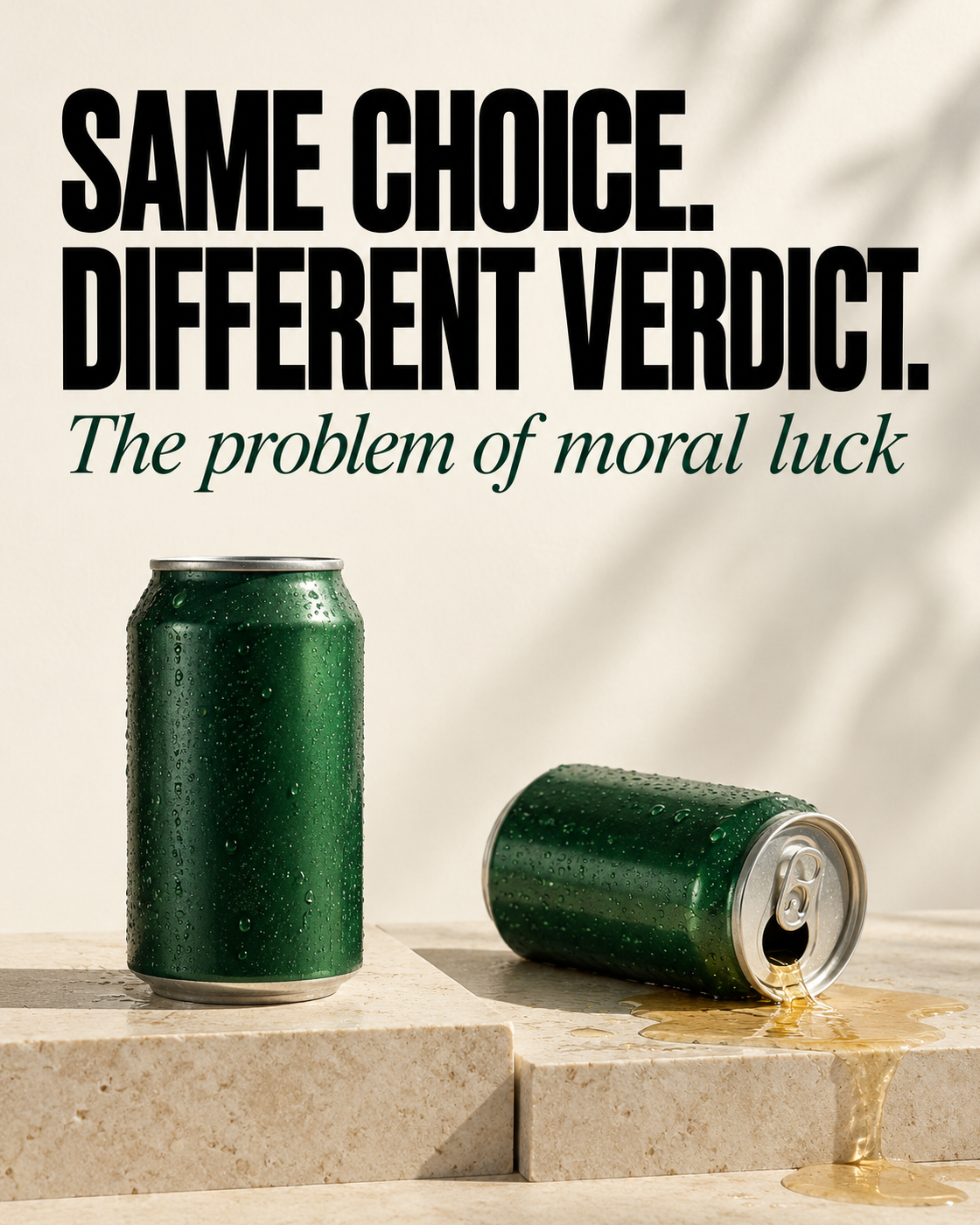
Two people can take the same reckless risk and face very different judgments because of something neither controlled.
Imagine two drivers who make equally negligent choices on different nights. One gets home without an incident. The other strikes a pedestrian who unexpectedly enters the road. The second driver has caused terrible harm. Yet the choices that created the risk were, by stipulation, equally bad.
Does the worse outcome make the second person morally worse? Or does it change what they must answer for without changing the blameworthiness of their choice?
This is the problem of moral luck.
1. The mechanism
Philosophers Bernard Williams and Thomas Nagel helped establish the modern debate in paired essays published in 1976. At its center is the control principle: we should morally assess people only for matters within their control.
You cannot choose exactly when another person crosses a street.
But ordinary moral judgments do not neatly follow that principle. We often judge harmful acts more severely when they produce injuries than when the same risky conduct happens to produce none.
Nagel distinguished several kinds of luck. Resultant luck concerns how an action turns out. Circumstantial luck concerns the situations someone happens to face. Constitutive luck concerns traits and dispositions shaped by circumstances beyond their choosing. Causal luck raises the deeper question of how much of any action ultimately lies under our control.
None of these labels proves that luck should alter moral responsibility. They identify a conflict philosophers still debate.
2. Why this is harder than it sounds
Return to the drivers. Both deserve criticism for creating an avoidable danger. The injured pedestrian also has a real claim for care and redress that does not arise in the no-injury case.
That difference need not imply different intentions or recklessness.
One philosophical response says the two are equally blameworthy for their choices, even though the consequences and obligations differ. Another argues that responsibility for actual harms cannot always be separated so cleanly from moral assessment.
The distinction matters: explaining unequal outcomes is not the same as excusing harmful conduct.
3. The bridge to decision-making
Applying moral luck to a business launch is an analogy, not a claim that revenue performance is a moral question.
Imagine two hypothetical beverage teams that independently make equally well-supported packaging decisions. They use comparable research, define sensible launch criteria, and document the risks.
After launch, one market experiences an unexpected competitor stockout. The other does not. The first team's numbers look excellent. The second team's look ordinary.
Would you conclude that the first creative team was better?
Not from those results alone. You would first ask how much of the difference was caused by the work, how much by external conditions, and what each team could reasonably know in advance.
There is experimental support for the broader judgment problem. In five studies published in 1988, Jonathan Baron and John Hershey found that people judged decision-making more favorably when outcomes were good, even when the information available at the time of the decision was held constant. That is outcome bias, a related empirical phenomenon, not a synonym for moral luck.
4. The assumption to challenge
“Good results prove a good decision.”
Good results matter. A company cannot pay suppliers with the quality of its intentions. And a poor result can reveal a risk that the team should have anticipated.
But separating process from outcome must not become an excuse to avoid accountability. Decisions should be reviewed against the evidence available at the time, while outcomes should still be investigated for lessons, repair, and future changes.
5. Your mental operator
Use three different lenses: What was knowable? What was controllable? What happened?
Do not collapse them into one verdict. Ask whether you would praise or condemn the decision in the same way if its outcome had been reversed.
6. Reasoning exercise
Two managers approve identical, properly tested limited-run launches. One market receives a surprise surge in demand because a competitor runs out of stock. The other market does not. One launch exceeds its target; the other misses.
Before reading the answer, decide: Who made the better decision? Who deserves the higher performance rating? What evidence would change your judgment?
Worked answer: The sales outcomes differ, but the description gives no basis for ranking the original decision quality. Performance pay may depend on results, but it is not a clean measure of judgment. Evidence of overlooked risk, poor execution, or a repeatable difference in consumer response would change the assessment.
Today's takeaway: Outcomes are real. Responsibility is real. But neither should erase the distinction between a decision and the luck surrounding it.
Research sources and notes
Verified sources | October 24, 2026
- Bernard Williams and Thomas Nagel (1976), Moral Luck, Proceedings of the Aristotelian Society, Supplementary Volumes, Vol. 50. Original journal record: https://www.jstor.org/stable/4106826
- Dana K. Nelkin, Moral Luck, Stanford Encyclopedia of Philosophy (substantive revision January 20, 2025): https://plato.stanford.edu/entries/moral-luck/
- Internet Encyclopedia of Philosophy, Moral Luck: https://iep.utm.edu/moralluc/
- Jonathan Baron and John C. Hershey (1988), Outcome Bias in Decision Evaluation, Journal of Personality and Social Psychology 54(4), 569-579. National Library of Medicine abstract: https://pubmed.ncbi.nlm.nih.gov/3367280/
The driver and beverage-launch scenarios are hypothetical examples. Moral luck is a disputed philosophical question, not an experimentally established universal rule. Outcome bias is a related but distinct empirical finding.
Educational editorial content. Hypothetical examples are labeled in the original edition.