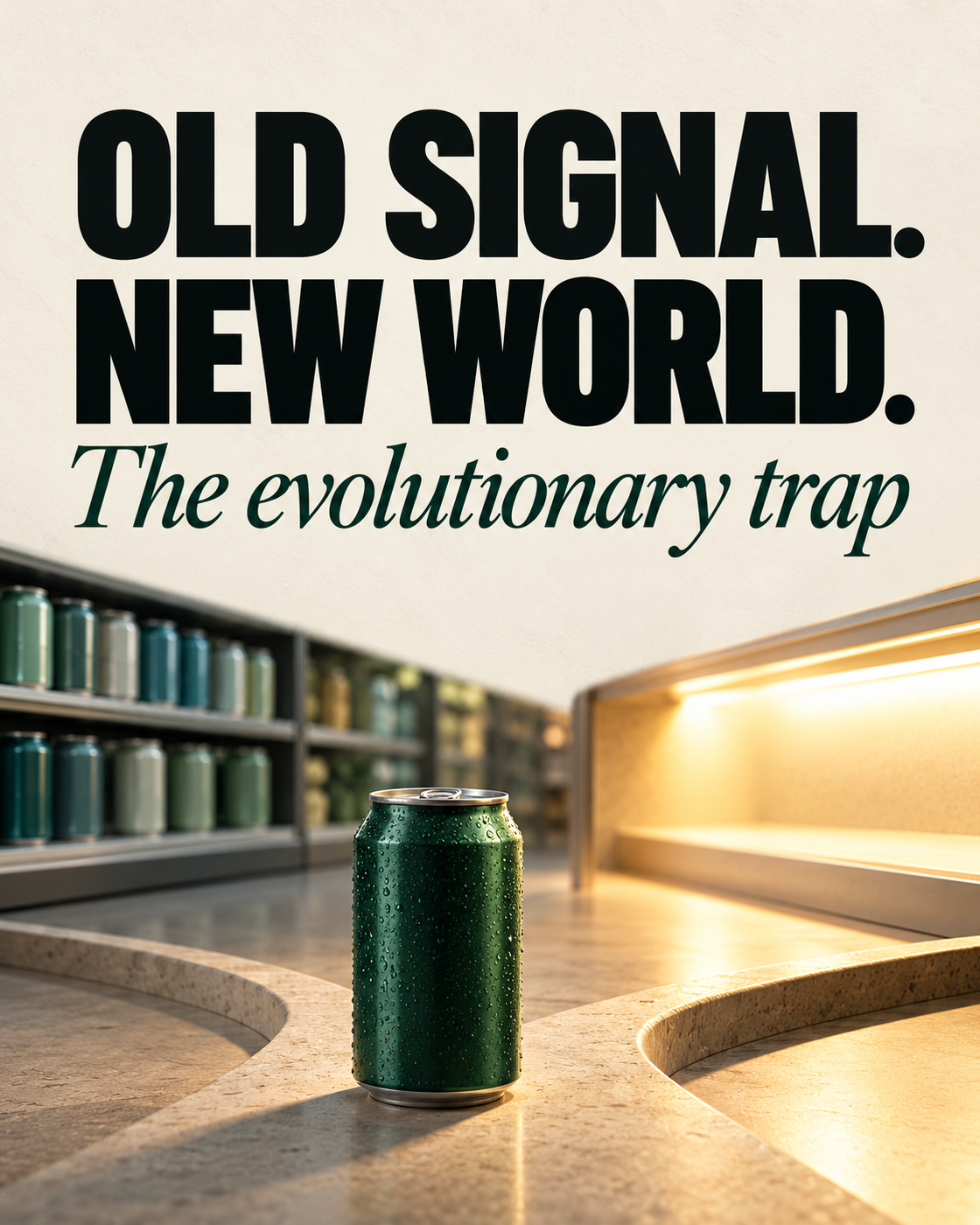
Sometimes an animal makes the decision its ancestors were best equipped to make, and that decision now leads it into danger. The instinct did not suddenly become foolish. The conditions changed.
1. The mechanism
In ecology, animals use cues to decide where to move, feed, reproduce, and settle. A cue is useful when it reliably predicts something that matters, such as safety or suitable habitat.
But a fast environmental change can break that relationship. A once-helpful response can lead to a harmful outcome. Researchers Martin Schlaepfer, Michael Runge, and Paul Sherman described these broader evolutionary traps in 2002.
There is an important distinction: an ecological trap is a narrower case in which an animal prefers a habitat where its survival or reproduction is worse than in available alternatives. Calling something an ecological trap requires evidence about both habitat preference and performance. Merely seeing animals in a dangerous place is not enough.
2. Outside business: sea turtles and artificial light
On a relatively natural beach, newly emerged sea turtles use a combination of visual cues, including the brighter open horizon toward the sea and darker landward silhouettes, to orient themselves.
Artificial beachfront lighting can overpower those cues. A hatchling may crawl inland toward a building or road while following the same orientation response that normally takes it toward water. That is a useful example of an evolutionary trap. It should not automatically be labeled the narrower habitat-choice version, an ecological trap.
A study published April 15, 2026, using Pinellas County, Florida, nesting surveys from 2018–2023, reported that 377 of 1,048 nests with hatchling emergence were associated with a disorientation event. That's approximately 36% of those nest emergences, not 36% of individual hatchlings and not a measured death rate. Artificial lighting was a major concern, while beach position and moonlight also mattered.
3. An application to beverage decisions
Now make a careful analogy, not a biological claim about shoppers.
Imagine a hypothetical beverage line where color has long helped loyal customers find their preferred flavor. A dark green can becomes their familiar shortcut. Over time, nearby products adopt similar colors, the portfolio grows, and the shelf layout changes.
Your team may keep praising the color because recognition studies once looked strong. But an old cue can stop being diagnostic of the choice you actually want consumers to make.
Before approving a bigger print run, test what happens now. Can shoppers spot the brand, identify the right flavor, and understand the product from a realistic shelf? Does the packaging set expectations the beverage can meet? Don't infer repeat purchase from noticing alone.
The commercial decision might be to preserve the familiar master-brand cue while making the flavor architecture more distinct, rather than throwing away the entire design system.
4. Challenge the assumption
“If a signal worked before, keeping it is the safest option.”
Not always. Past evidence establishes what worked in the conditions of that test. It does not automatically establish what works after the context changes.
But there is a real counterargument: shortcuts are efficient precisely because they spare people constant reevaluation. Familiar cues can carry real recognition value. A changing category does not automatically justify a redesign, and human choice is far more flexible than turtle navigation.
The answer is not to distrust every signal. It is to check whether the relationship between cue and result still holds.
5. Your mental operator
Ask four questions: What cue am I using? What result did it originally predict? What changed around it? What would tell me it still works?
Use this with brand research, an old process, or even a personal habit. ### 6. Reasoning exercise: answer before reading on
Two hypothetical packaging options are each shown to 100 randomly assigned shoppers in comparable shelf conditions.
- Option A: 70 notice the can; 49 select the intended flavor correctly.
- Option B: 58 notice the can; 52 select the intended flavor correctly.
Which is more noticeable? Which produces more correct selections? Does this prove one will sell more?
Worked answer
A is noticed more often: 70% versus 58%. B leads to slightly more correct flavor selections: 52% versus 49%. The difference in correct selection is small and needs uncertainty and replication checks. Neither test establishes repeat purchase or sales lift.
Takeaway: An old signal can remain attractive after it stops being useful. Measure where it leads people today.
Research sources and notes
- Schlaepfer, Runge & Sherman (2002), Ecological and evolutionary traps — Defines evolutionary-trap mechanism and narrower habitat-choice ecological traps.
- Robertson & Hutto (2006), A framework for understanding ecological traps87[1075:AFFUET]2.0.CO;2) — Criteria and caveats for establishing ecological traps.
- Florida Fish and Wildlife Conservation Commission, Artificial Lighting and Sea Turtle Hatchling Behavior — Official mechanism of sea turtle visual orientation and artificial-light disruption.
- McNally et al. (2026), Disorientation patterns of loggerhead sea turtle hatchlings in Pinellas County — 2026 primary observational evidence, 2018–2023 emergence counts and explanatory limitations.
Educational editorial content. Hypothetical examples are labeled in the original edition.