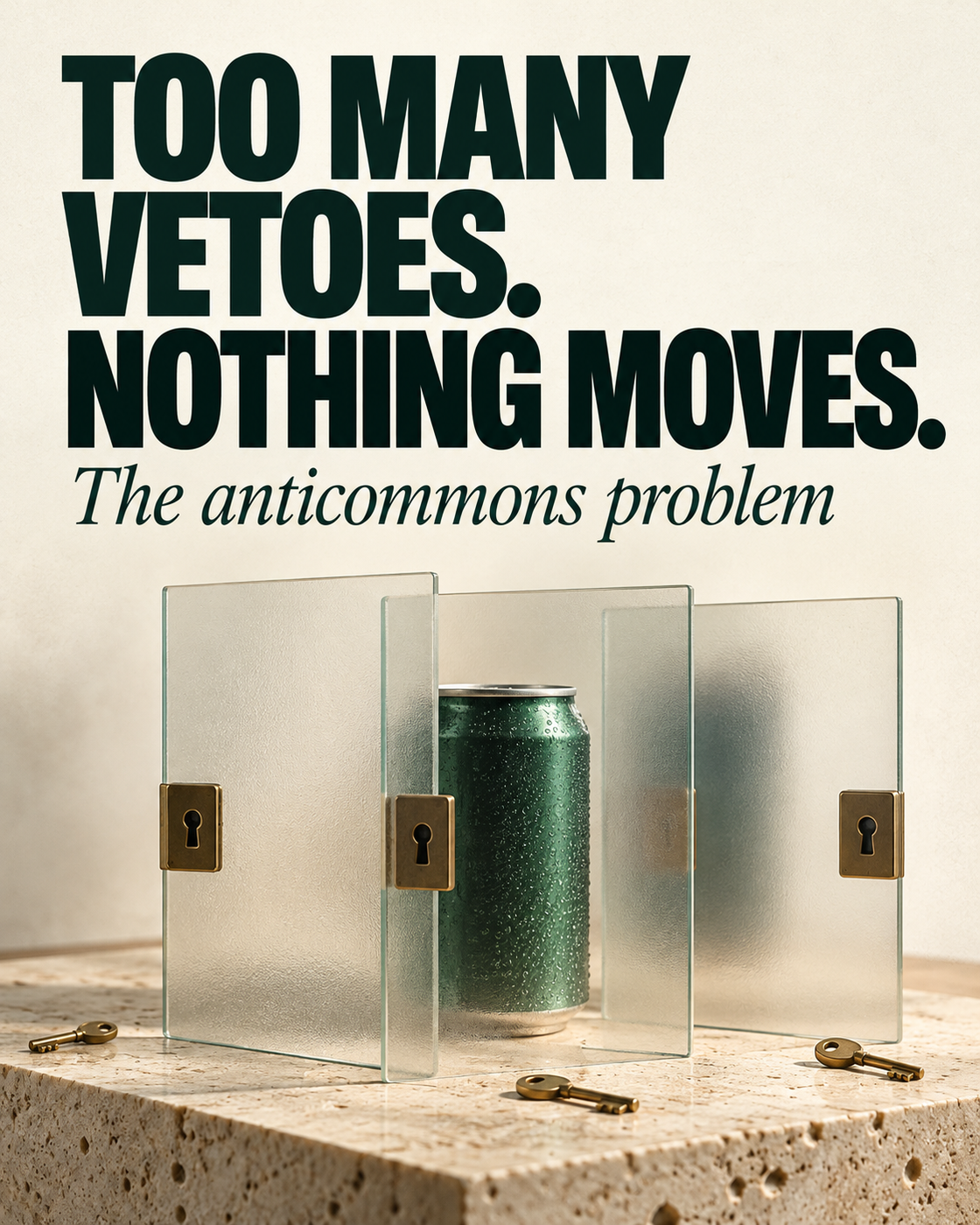
A shop can have a location, willing customers, and goods ready to sell, yet remain empty because no one person can authorize its use.
This is the opposite of a familiar problem. In a commons, many people can use a resource, sometimes exhausting it. In an anticommons, too many separate parties can prevent its use. The result can be underuse, even when putting the resource to work would create value.
1. The mechanism
In a 1998 Harvard Law Review article, legal scholar Michael Heller described the anticommons as a situation in which multiple owners possess rights to exclude others from a scarce resource, but nobody has a practical right to use it without obtaining agreement from the others.
The problem is separate permissions that are all necessary. Each rights holder may have sound reasons to protect their interest. Collectively, though, negotiation costs, incompatible demands, and the chance of a holdout can prevent a deal.
Heller's argument is a theory about property institutions, not a mathematical rule that every additional approver automatically destroys value.
2. Outside CPG: Moscow storefronts
Heller used a striking puzzle from post-socialist Moscow: storefronts were empty while nearby street kiosks were active. He argued that fragmented claims to storefront property and decisions about use helped explain why physically available commercial space could remain unused.
This was a historically grounded case study and an explanation offered by the author, not proof that fragmented rights caused every empty storefront. Other economic and institutional conditions can matter too.
A building may look available without being legally or practically usable. A resource can sit idle not because nobody wants it, but because no one can assemble the permissions needed to activate it.
A related application appeared in a 1998 Science article by Heller and Rebecca Eisenberg. They warned that fragmented patent rights could complicate downstream biomedical research. In later empirical work, Fiona Murray and Scott Stern found a modest decline in scientific citations after patent grants among the patent-paper pairs they studied. That does not prove patents always impede science.
3. A commercial application
Imagine a hypothetical co-branded beverage release. A trademark partner controls one piece of the artwork, a second licensing partner controls another, and a retailer requires approval of a promotional use. Meanwhile, internal teams review formula accuracy and regulatory claims.
Those aren't all the same kind of approval. Legal rights to say no differ from useful feedback, production signoff, and non-negotiable safety checks.
Before spending on concept renders or print proofs, I'd map the rights needed to make the actual product. Can one consolidated agreement cover the intended uses? Can the owners agree on one review window and precise approval criteria? Can a design option avoid an unnecessary licensing dependency without weakening the concept?
The practical move isn't to bypass a rights holder. It's to discover the permissions problem before the creative work becomes expensive to unwind.
4. The assumption and counterargument
Assumption worth challenging: “Giving everyone final approval is the safest way to protect the project.”
Sometimes review is essential, and veto rights can prevent exploitation, dangerous claims, and violations of intellectual property. Removing them indiscriminately would create new risks. Sometimes a single owner also causes more problems than many.
The sharper question is whether each party truly needs an independent power to block, and whether the approvals can be coordinated lawfully. Streamlined decision rights must preserve legitimate ownership and compliance authority.
5. Your mental operator
Count the vetoes, not the meeting attendees. For each required permission, write down who owns it, what they can block, when they must decide, and whether there is an acceptable alternative.
Distinguish required consent, advice, and accountability.
6. Reasoning exercise: answer before reading on
In a purely illustrative model, every required rights holder independently approves a proposed use with probability 80%. All approvals must be obtained.
What is the chance of success with three rights holders? How about four? Does adding one required consent reduce the chance by 20 percentage points?
Worked answer
With three independent approvals: 0.8 × 0.8 × 0.8 = 0.512, or 51.2%.
With four: 0.8⁴ = 0.4096, or 40.96%. The difference is 10.24 percentage points, not 20.
This is not a forecast of real licensing negotiations. Approval decisions often influence one another, and probabilities need evidence. It simply shows how stacked necessary conditions behave under stated assumptions.
Today's takeaway: More owners can mean more protection. But when everyone can block and nobody can assemble the necessary permissions, valuable work may never start.
Research sources and notes
Research sources
- Michael A. Heller (1998). The Tragedy of the Anticommons: Property in the Transition from Marx to Markets. Harvard Law Review 111: 621–688. Columbia Law School repository. https://scholarship.law.columbia.edu/faculty_scholarship/477/
- Michael A. Heller and Rebecca S. Eisenberg (1998). Can Patents Deter Innovation? The Anticommons in Biomedical Research. Science 280: 698–701. PubMed record. https://pubmed.ncbi.nlm.nih.gov/9563938/
- Fiona Murray and Scott Stern (2005 working paper; published 2007). Do Formal Intellectual Property Rights Hinder the Free Flow of Scientific Knowledge? An Empirical Test of the Anti-Commons Hypothesis. National Bureau of Economic Research Working Paper 11465. https://www.nber.org/papers/w11465
- Michael A. Heller (2013). The Tragedy of the Anticommons: A Concise Introduction and Lexicon. Modern Law Review. https://onlinelibrary.wiley.com/doi/abs/10.1111/1468-2230.12000
Verification notes: Historical examples attributed to Heller's analysis; biomedical research concerns in the 1998 paper are hypotheses about institutional effects. The Murray-Stern result is a study-specific association estimated using differences-in-differences, not a universal effect. The beverage collaboration is hypothetical. The probability exercise is illustrative with explicit independence and common approval-rate assumptions.
Educational editorial content. Hypothetical examples are labeled in the original edition.