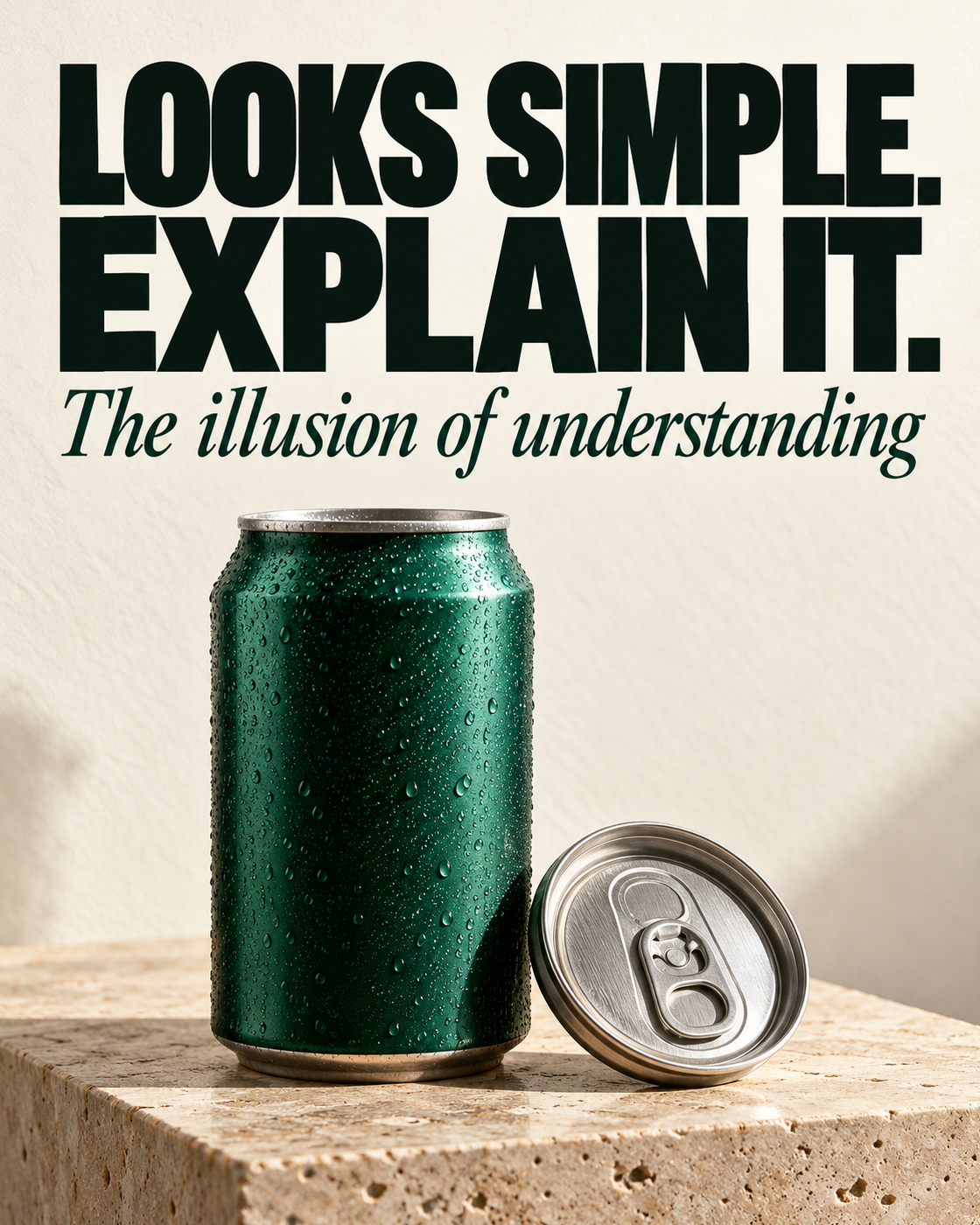
You can use something every day and still have almost no idea how it works. The unsettling part is that you may feel certain you understand it.
In 2002, psychologists Leonid Rozenblit and Frank Keil studied what they called the illusion of explanatory depth. Participants rated how well they understood familiar devices, including zippers, flush toilets, and helicopters. Then they had to write detailed explanations of the mechanisms. Their self-ratings typically fell after they tried to explain. This was not simply a test of remembering definitions. It exposed the distance between recognizing what a system does and being able to explain how it does it.
1. The mechanism
Consider three different claims: "I know what this is," "I know how to use it," and "I know why it works." They are not interchangeable.
The first two can be true while the third is false. Familiar objects do part of the thinking for us. We see their moving parts, observe results, and can often reconstruct pieces of an explanation on the spot. Researchers proposed that we sometimes mistake this support from the environment, or from knowledge held by other people, for detailed knowledge inside our own heads.
That explanation is a research interpretation, not proof that one psychological mechanism causes every instance. The original research also found stronger overconfidence for causal explanations than for remembering facts, procedures, or movie plots. The effect is not a universal statement that people know nothing.
2. Outside CPG: a zipper
Think about a jacket zipper. You may have opened thousands without thinking. Before reading further, could you explain exactly how two rows of teeth lock and unlock?
The manufacturer YKK describes three main parts: interlocking elements, fabric tape, and the moving slider. Inside the slider is a Y-shaped passage. Moving it one way guides the two rows into engagement; moving it the other way separates them. The shapes and dimensions of the elements matter.
Knowing that the zipper "joins fabric" tells you its purpose. Explaining the Y-shaped passage and tooth geometry begins to tell you its mechanism. Both kinds of knowledge are useful, but they answer different questions.
3. Apply it to a beverage decision
Imagine a hypothetical packaging review. Everyone agrees that a new flavor system is "intuitive." The team has seen the cans repeatedly. They know which color belongs to each flavor. It feels obvious.
But how, exactly, would a first-time shopper move from seeing a color, to reading a flavor, to choosing the correct can on a crowded shelf? What happens when two flavors share similar hues? What changes when the cans are partly hidden or viewed from a distance?
The commercial decision is to test first-time flavor finding, not just ask the room whether the design feels clear. Give unfamiliar participants specific shelf tasks, record correct selections and mistakes, and separate brand recognition from SKU identification. Keep any required compliance or product information intact.
4. Challenge the assumption
"If the team can describe the idea confidently, we understand the experience."
Maybe. Experts can correctly predict some outcomes without articulating every mechanism. And nobody needs to explain the chemistry of ink to choose a readable label. A demand for exhaustive explanations can become performative and slow decisions down.
The more useful standard is proportional: require a credible causal explanation for the specific claim being used to justify the decision, then check it against observation where the stakes warrant it. A compelling explanation is still not evidence that the predicted consumer behavior will occur.
5. Your mental operator
Use Rate, Explain, Test. First, rate your understanding from 1 to 7. Next, explain the mechanism in plain steps without reaching for a definition or slogan. Mark the first point where you are guessing. Finally, consult evidence or design a test that could prove your explanation wrong.
6. Reasoning exercise: answer before reading on
In an illustrative sample of 20 unfamiliar shoppers, 15 say they understand a package descriptor. Only 6 can correctly explain what it means under an independently defined scoring rule.
What are the two percentages? What is the gap? And what can't the result prove?
Worked answer
Self-reported understanding is 15/20 = 75%. Demonstrated understanding is 6/20 = 30%, a gap of 45 percentage points. This small hypothetical sample suggests a mismatch under those conditions. It does not prove the descriptor caused the misunderstanding, establish a population-wide rate, or predict sales. You would need a better-designed comparison and an appropriate sample for those claims.
Today's takeaway: Familiarity can make a mechanism feel obvious. Try explaining the link between cause and result before trusting that feeling.
Research sources and notes
Research sources | Carlos Upgrade | October 30, 2026
- Rozenblit, Leonid, and Frank Keil (2002), "The misunderstood limits of folk science: an illusion of explanatory depth," Cognitive Science 26(5), 521-562. Original research, available via NIH PMC: https://pmc.ncbi.nlm.nih.gov/articles/PMC3062901/
- YKK, "To begin with, what's the structure of a zipper?" Manufacturer explanation of elements, tape and Y-shaped slider: https://www.ykk.com/english/ykk/tech/01.html
- Fernbach, Philip M., Todd Rogers, Craig R. Fox, and Steven A. Sloman (2013), "Political Extremism Is Supported by an Illusion of Understanding," Psychological Science 24(6), 939-946. Later experimental extension distinguishing mechanistic explanations from listing reasons: https://www.hks.harvard.edu/publications/political-extremism-supported-illusion-understanding
The beverage example, shopper counts and any commercial recommendations are hypothetical applications, not published empirical findings.
Educational editorial content. Hypothetical examples are labeled in the original edition.