Carlos Upgrade | November 3, 2026 | Philosophy and language
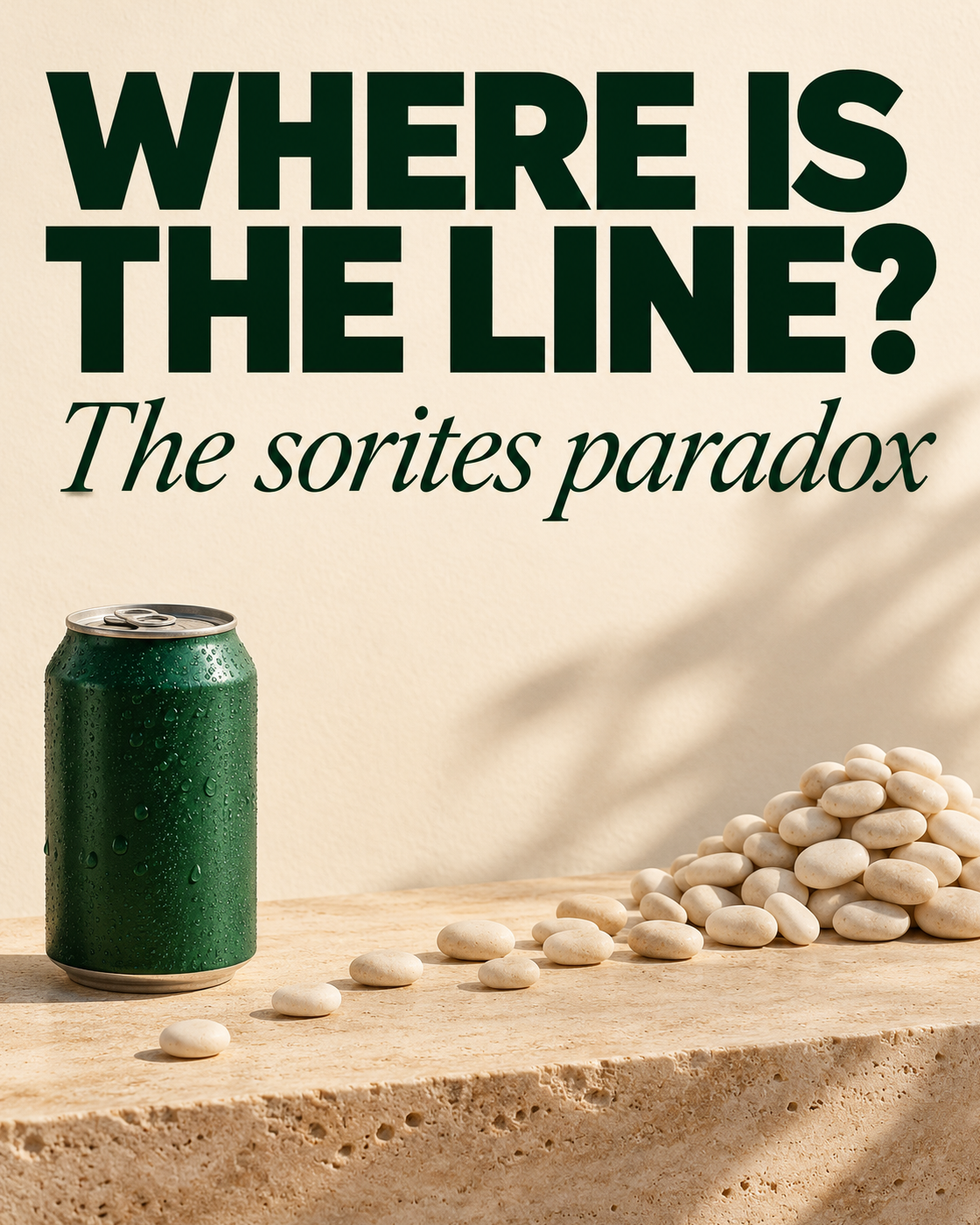
One grain of sand is not a heap. A million grains are. So which grain turns a collection into a heap?
It sounds like a harmless language question. But it exposes a problem in how we make decisions about gradual change.
1. The mechanism
The sorites paradox, usually attributed to the fourth-century BCE philosopher Eubulides, takes its name from a Greek word for heap. It concerns vague predicates: words such as “tall,” “old,” “rich,” or “heap” that have clear cases and borderline cases.
Here is the tempting argument. One grain is not a heap. Adding one grain cannot possibly change that. So two grains are not a heap. Neither are three. Repeat the same seemingly reasonable step enough times, and you conclude that a million grains cannot form a heap. Clearly something has gone wrong.
The trap is tolerance: treating a tiny difference as incapable of changing a category, then applying that assumption indefinitely. The logical steps can look impeccable while the universal premise about every adjacent pair is not defensible.
Philosophers disagree about the best explanation. Some defend a sharp boundary whose location we cannot know. Others treat borderline cases as admitting degrees or as lacking a determinate classical truth value. There is no single universally accepted resolution. [1][2]
2. Outside CPG: editing a photograph
Imagine a photographer makes 60 versions of a landscape, increasing saturation by one small fixed step each time. This is an illustrative scenario, not an experiment.
Version 1 looks natural. Version 60 looks aggressively processed. Compare versions 20 and 21, and the difference might be hard to notice. Compare versions 1 and 60, and the overall transformation is obvious.
“Natural-looking” is a judgment with fuzzy edges. The mistake would be insisting that because no adjacent pair is clearly different, all 60 versions must be equivalent. The endpoint comparison exposes the accumulated change. But it does not reveal one objectively correct saturation value at which “natural” becomes “unnatural.”
3. A commercial decision
Imagine a hypothetical beverage team making incremental packaging revisions. Each round adjusts flavor typography, color contrast, and brand size only slightly. Every local change seems acceptable.
After twelve rounds, the newest pack might be harder for unfamiliar shoppers to identify than the approved original. That possibility needs testing, not a confident assertion.
Before approving another revision, compare the first approved version with the proposed final version, side by side, in a realistic shelf setting. Ask new shoppers to find the brand and the correct flavor. Check legibility, accessibility, required disclosures, print constraints, and consistency across the portfolio.
Set decision criteria before reviewing the latest artwork. A minimum tested recognition rate or a clear flavor-finding standard is an operational rule, not proof of a metaphysical line separating good design from bad design. The rule is there to support a specific business choice.
4. Challenge the assumption
Assumption to test: “If every individual revision is minor, the final result cannot be materially different.”
The sorites shows why that reasoning is unsafe. Many small changes can add up, even if no single step feels decisive.
Counterargument: Not every vague question requires a sharp threshold. Forcing binary labels onto complex judgments can erase useful information. Experienced designers can use gradients, uncertainty ranges, and informed judgment rather than pretending every decision has a single magic cutoff. Some decisions, especially compliance requirements, already have binding definitions that cannot be replaced by a subjective design test.
5. Your mental operator
Use an endpoint audit. Compare the original and final states without the intermediate versions. Identify what changed cumulatively. Decide whether the question requires a measured threshold, a graded assessment, or honest acknowledgment of a borderline case.
6. Reasoning exercise: solve before reading
In an illustrative design sequence, a flavor name starts at 40 points. A designer reduces it by exactly 1 point in each of 12 revisions. What is the final size? What percentage smaller is it than the original? Does that arithmetic prove the flavor has become unreadable?
Worked answer
The final size is 28 points. The reduction is 12/40 = 30%. No individual one-point revision is a 30% change, but the total is.
This does not establish unreadability. Legibility depends on typeface, weight, contrast, viewing distance, reproduction, audience, and context. Test the outcome that matters rather than declaring a universal visual threshold.
Keep this: When every local change seems harmless, inspect the distance between the endpoints.
Sources
[1] Stanford Encyclopedia of Philosophy, “Sorites Paradox” (revised August 26, 2025): https://plato.stanford.edu/entries/sorites-paradox/
[2] Stanford Encyclopedia of Philosophy, “Vagueness” (revised June 16, 2022): https://plato.stanford.edu/entries/vagueness/
Research sources and notes
Research sources | November 3, 2026
Stanford Encyclopedia of Philosophy, “Sorites Paradox.” First published January 17, 1997; substantive revision August 26, 2025. https://plato.stanford.edu/entries/sorites-paradox/ Supports Eubulides attribution (customarily), Greek “heap” origin, the sorites argument, the tolerance premise and several rival theories.
Stanford Encyclopedia of Philosophy, “Vagueness.” First published February 8, 1997; substantive revision June 16, 2022. https://plato.stanford.edu/entries/vagueness/ Supports borderline cases, the distinctions among theories, and the practical difficulty of locating precise boundaries for ordinary predicates.
Research claims were checked against both live authoritative entries on November 3, 2026. Photography, beverage packaging, numerical figures, and shop-floor decisions in the lesson are explicitly illustrative, not research findings.
Educational editorial content. Hypothetical examples are labeled in the original edition.