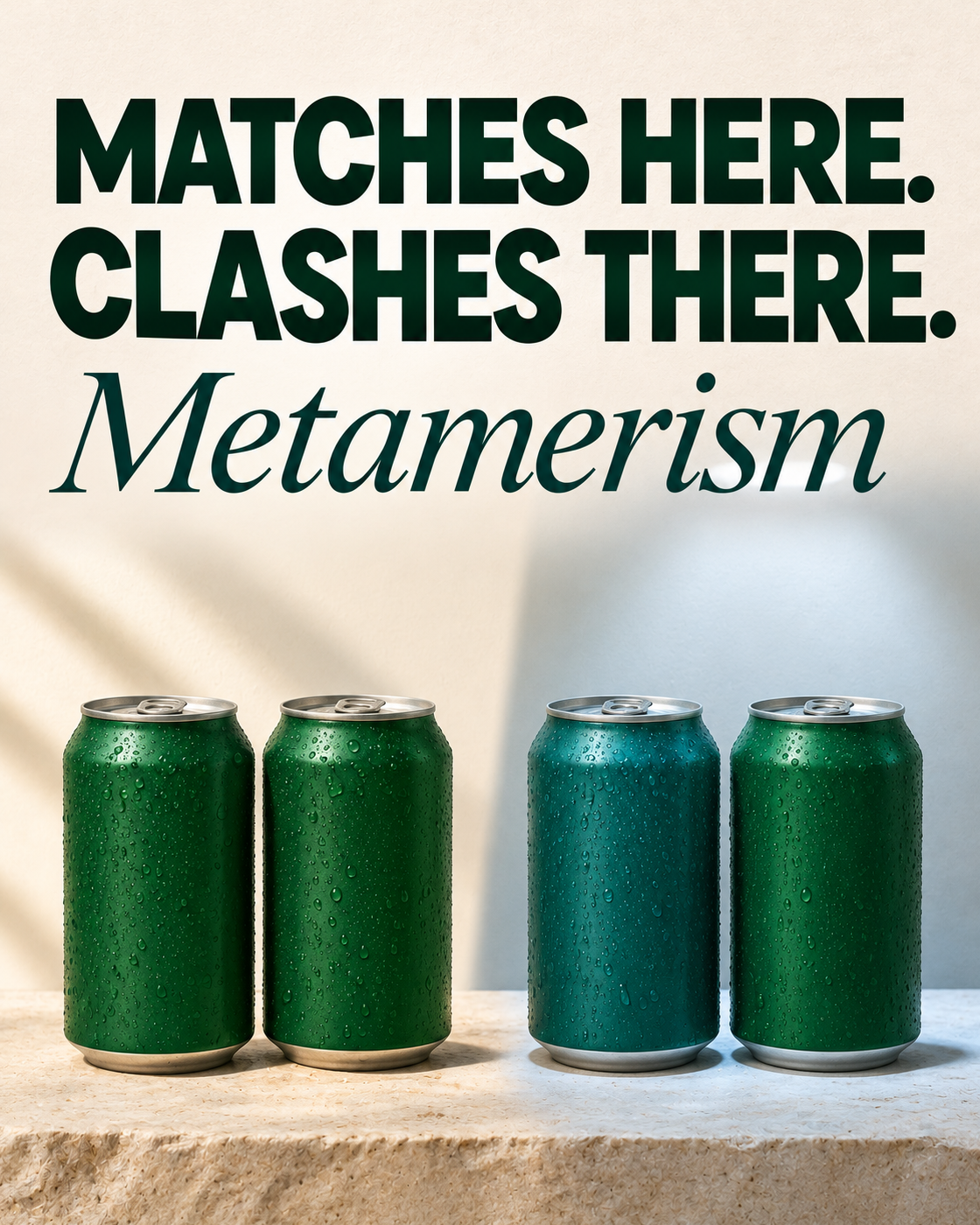
Carlos Upgrade | November 4, 2026 | Color science
Two pieces of material can look like exactly the same green in one room, then look noticeably different in another. Neither piece has changed. The light has.
That is the problem behind metamerism. And it raises a useful question far beyond color: when we say two things are equivalent, have we checked the conditions under which that statement is true?
1. The mechanism
Your eyes do not read an object's complete spectrum of reflected light, wavelength by wavelength. Human color vision compresses incoming light into responses from three broad classes of cone photoreceptors. Different spectra can produce the same color response.
The International Commission on Illumination (CIE) calls such spectrally different but color-matching stimuli metamers. If two surfaces reflect different combinations of wavelengths, they can match under a particular light source and standard observer. Change the spectral makeup of the light, and their apparent colors may diverge. A change of observer can also break some matches.
The distinction matters: ordinary lighting changes can alter both samples. Metamerism specifically concerns a spectral match that breaks under changed conditions.
2. Outside CPG: the tailored jacket
Imagine a tailor repairing a dark-blue jacket with new fabric. Under the workshop lamp, the replacement panel looks identical to the original. Outside in daylight, the repair appears purple while the jacket remains blue.
This is an illustrative example, not a documented experiment. It is consistent with illuminant metamerism if the two fabrics have different spectral reflectance but matched under the workshop light. Weave, sheen or viewing angle might also explain it.
The lesson is that a successful comparison under one light source is not always transferable to a second one.
3. Where this matters commercially
Consider a hypothetical beverage launch with a printed carton and an aluminum can. A supplier adjusts the inks so both appear to share the same forest green under a controlled viewing booth. The creative team approves the color.
Later, under a store's LED lighting, the carton looks slightly olive and the can looks teal. Maybe their inks have different spectral responses. Maybe coatings or gloss are involved. The root cause needs measurement, not guessing.
Do not redesign everything immediately. Before approving production, compare actual printed substrates and finishes under a controlled reference condition and under representative retail lighting. Where a mismatch matters, ask the printer or color specialist for spectral measurements and a practical correction. Keep required product information legible throughout.
ISO 3664:2025 sets viewing conditions for critical comparisons in graphic technology and photography. It is a useful standard for controlled review, not a promise that every store uses that lighting. NIST's research on color rendition likewise shows why light-source spectra affect how objects' colors are represented.
4. An assumption worth challenging
“If the sample matches in the approval room, the color is approved everywhere.”
That conclusion assumes the viewing condition can stand in for every relevant environment. It often cannot.
But here is the counterargument: demanding perfect agreement under every light, surface and observer may be impossible or commercially wasteful. Standardized review is valuable precisely because it makes decisions repeatable. Instead, identify relevant environments, set tolerances and test them.
5. Your mental operator
Use Change the conditions. Before calling two outputs equivalent, identify the environment that makes them appear equivalent. Then deliberately vary one relevant condition. Ask whether the decision still holds, and whether any difference changes the outcome you care about.
It works for colors, but also for a presentation that reads clearly on a laptop yet fails on a projector, or a product message that makes sense to insiders yet confuses new shoppers. Those are analogies, not instances of optical metamerism.
6. Reasoning exercise: answer first
In a hypothetical print test, 12 sample pairs match acceptably under the reference booth. Under a representative retail LED, only 9 do. What fraction failed the second check? Does that establish the failure rate across all retailers?
Worked answer
Three of 12 pairs failed, so 3/12 = 25%. That's the observed rate in this invented sample and under that particular test. It does not establish a 25% failure rate in every store or prove that metamerism caused all three failures. You would need representative lighting conditions, a defined acceptance rule and an investigation of each mismatch.
Keep this: A match is not just a property of two objects. It can be a property of two objects under particular conditions.
Sources
CIE metamerism, CIE observer/illuminant report, ISO 3664:2025, and NIST on color rendition.
Research sources and notes
Research sources | Metamerism | November 4, 2026
International Commission on Illumination (CIE), CIE 080-1989, Special metamerism index: Change in observer. Authoritative technical definition: spectrally different specimens can match for one illuminant and reference observer and diverge when either changes. https://www.cie.co.at/publications/special-metamerism-index-change-observer
CIE S 017:2020 International Lighting Vocabulary, term 17-23-006, Metamerism. Definition of spectrally distinct stimuli with matching tristimulus values under a specified colorimetric system. https://cie.co.at/eilvterm/17-23-006
ISO 3664:2025, Graphic technology and photography, Viewing conditions. Current international standard specifying conditions for critical appraisal and comparison of printed and photographic materials (published July 2025). https://www.iso.org/standard/83759.html
Ohno et al. (2015), Development of the IES method for evaluating the color rendition of light, NIST / Optics Express. Describes how characteristics of light sources affect rendition and color fidelity relative to a reference illuminant. https://www.nist.gov/publications/development-ies-method-evaluating-color-rendition-light
Notes: The tailor, packaging and numerical examples are hypothetical. Material gloss, finish, fluorescence, viewing geometry and observer variation can also affect color appearance. Metamerism is a specific spectral color-match phenomenon, not a blanket explanation for every mismatch. The cover is a conceptual illustration, not a measured demonstration of optical metamerism.
Educational editorial content. Hypothetical examples are labeled in the original edition.