Carlos Upgrade | November 5, 2026 | Psychology and problem-solving
A chess expert can see a winning move and miss a faster win sitting on the same board. Sometimes expertise makes the first plausible answer especially hard to escape.
1. The mechanism
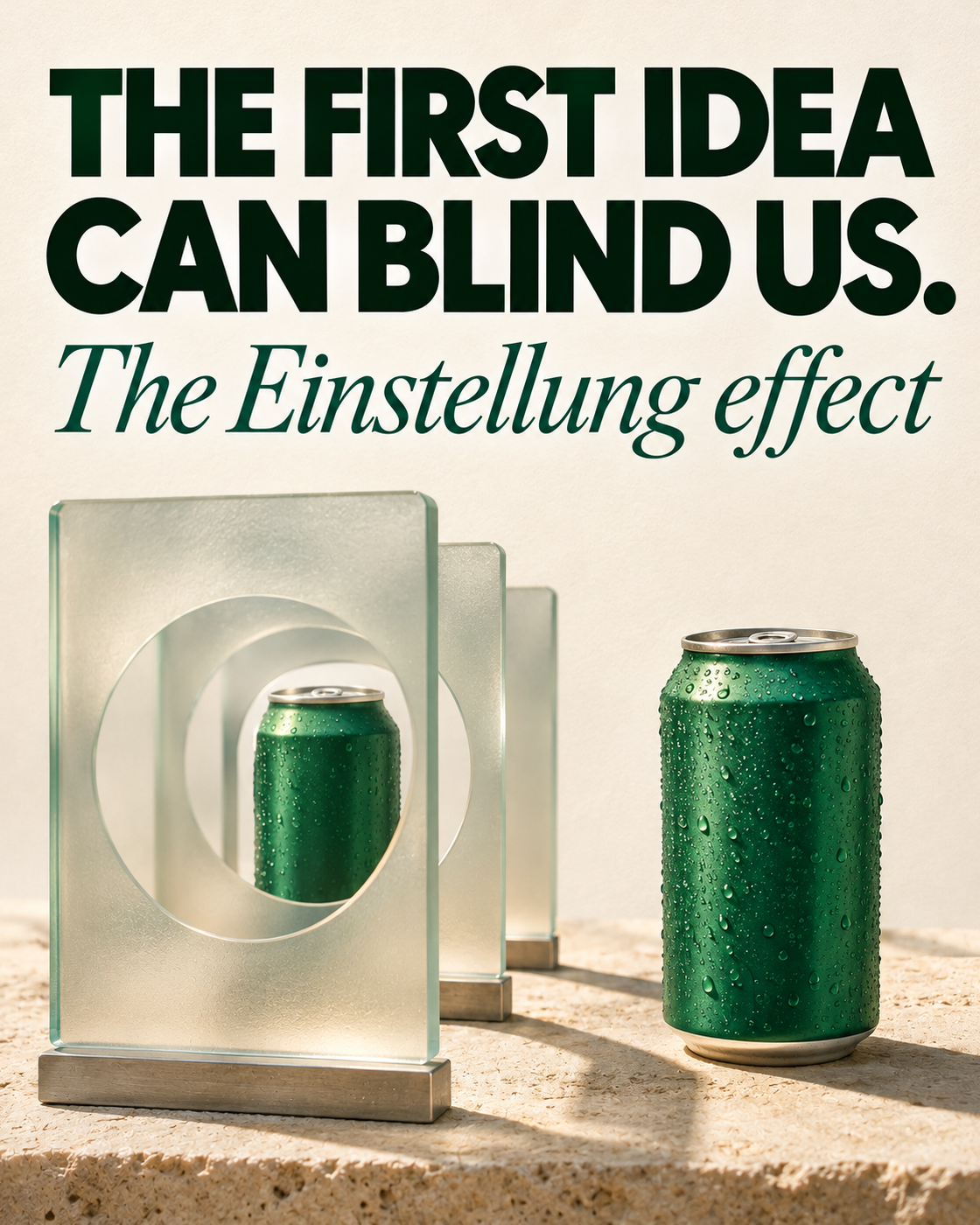
Psychologists call this the Einstellung effect, or mental-set effect. A familiar problem activates a learned approach. That approach can solve the problem, but it also directs attention toward information that fits the approach and away from alternatives.
Abraham Luchins demonstrated the effect in 1942 using water-jar puzzles. After participants learned a multi-step method, some kept applying it to later puzzles that allowed simpler solutions. In certain tasks, prior practice even made a solvable problem seem impossible.
Later studies provided a more specific account. In a 2008 chess experiment, researchers Merim Bilalić, Peter McLeod and Fernand Gobet asked experienced players to find the quickest checkmate. A familiar five-move route could distract them from a three-move route. Eye tracking showed that players who said they were searching for something better still spent attention on squares associated with the familiar solution.
A useful mental pattern can narrow the search that follows.
2. Outside CPG: the chessboard
A chess player sees a recognizable arrangement and immediately spots a winning sequence. That recognition is normally a strength.
But in the experiment, that strength created a specific vulnerability: finding a workable move reduced the chance of noticing a shorter one elsewhere on the board. The question was whether a faster route existed.
A 2013 follow-up found an important boundary. When a familiar move was merely good but suboptimal, it could hold attention. When the familiar move was an obvious blunder, expert players generally avoided it. The problem is especially interesting when the first answer is good enough to feel safe.
3. The beverage decision
Imagine a hypothetical beverage brand is missing its sales target in 50 stores. The team's usual response is a price promotion. Someone proposes a 20% discount because that has worked before.
Before approving it, ask for a competing explanation: are the products actually available, correctly placed and visible in those stores? A discount cannot fix every shelf execution problem, and a shelf correction cannot fix every pricing problem.
A concrete decision would be to compare store-level in-stock and placement data, then test the proposed promotion against an execution fix where conditions permit. Define success in advance using incremental units, contribution after discount and retailer costs, not just gross sales.
The Einstellung risk is not “promotions are bad.” It is treating a familiar lever as the only serious option before defining the problem.
4. The assumption and counterargument
Assumption to challenge: Experienced people naturally see more solutions.
Experts often do see more relevant patterns and work faster. Their shortcuts can be accurate and efficient. Searching for alternatives to every small decision would waste time.
The research does not establish that novices are generally better than experts. It identifies circumstances where a familiar but suboptimal solution captures attention. Its cost depends on the stakes and alternatives.
5. Your mental operator
Use Solve, then reopen. First, write the obvious solution. Then temporarily forbid it and ask for one different mechanism that could produce the same outcome. Seek evidence that would separate the explanations. Reopen the search only when the decision is consequential enough to justify it.
6. Reasoning exercise: answer before reading on
In an illustrative water-jar puzzle, you have containers holding 27, 12 and 3 cups. You must leave exactly 9 cups in one jar, and you may fill, empty or transfer measured amounts. You remember a method: start with 27, remove 12, then remove 3 twice. Can you find a shorter route? How many removals does each route require, assuming those amounts can be transferred exactly?
Worked answer
The familiar route leaves 27 − 12 − 3 − 3 = 9 cups, using three removals. Start with the 12-cup jar instead and remove 3: 12 − 3 = 9 cups, using one removal. Both reach the target. One is simpler.
The numbers are invented for this exercise; they are not reported results from Luchins's experiments.
Keep this: The first solution can be useful without being the best. If the stakes are high, deliberately look where your first answer did not make you look.
Research
- Bilalić, McLeod & Gobet (2008), Cognition: https://pubmed.ncbi.nlm.nih.gov/18565505/
- Sheridan & Reingold (2013), PLOS ONE: https://pmc.ncbi.nlm.nih.gov/articles/PMC3790829/
- Vallée-Tourangeau, Euden & Hearn (2011), Quarterly Journal of Experimental Psychology: https://journals.sagepub.com/doi/10.1080/17470218.2011.605151
Research sources and notes
Research sources | November 5, 2026
Research was checked against the following original peer-reviewed studies and their abstracts/full text on November 5, 2026. All links are stable HTTPS research destinations.
- Bilalić, M., McLeod, P., & Gobet, F. (2008). Why good thoughts block better ones: The mechanism of the pernicious Einstellung (set) effect. Cognition, 108(3), 652–661. https://pubmed.ncbi.nlm.nih.gov/18565505/
- Expert chess players' eye movements continued to favor locations associated with a familiar, suboptimal solution. Supports attentional interpretation; does not imply expertise is generally harmful.
- Sheridan, H., & Reingold, E. M. (2013). The mechanisms and boundary conditions of the Einstellung effect in chess: Evidence from eye movements. PLOS ONE, 8(10), e75796. https://pmc.ncbi.nlm.nih.gov/articles/PMC3790829/
- Separates familiar but suboptimal moves from familiar blunders. In the blunder condition, experienced players usually rejected the familiar move. This supplies an important boundary condition.
- Vallée-Tourangeau, F., Euden, G., & Hearn, V. (2011). Einstellung defused: Interactivity and mental set. Quarterly Journal of Experimental Psychology, 64(10), 1889–1895. https://journals.sagepub.com/doi/10.1080/17470218.2011.605151
- Discusses Luchins's 1942 water-jar experiments and reports that hands-on interactivity reduced perseveration in two experiments.
Evidence versus illustration: The chess and jar phenomena are documented research; the 50-store beverage case, 20% promotion, and 27/12/3-cup reasoning exercise are fictional illustrations. No empirical effect sizes, revenue outcomes, or business performance improvements are asserted.
Educational editorial content. Hypothetical examples are labeled in the original edition.