Carlos Upgrade | November 7, 2026 | Psychology and memory
A longer unpleasant experience can sometimes be the one people choose to repeat. Not because they enjoyed more discomfort, but because of how it ended.
That sounds backwards. It also reveals a difference between living through an experience and remembering it later.
The mechanism
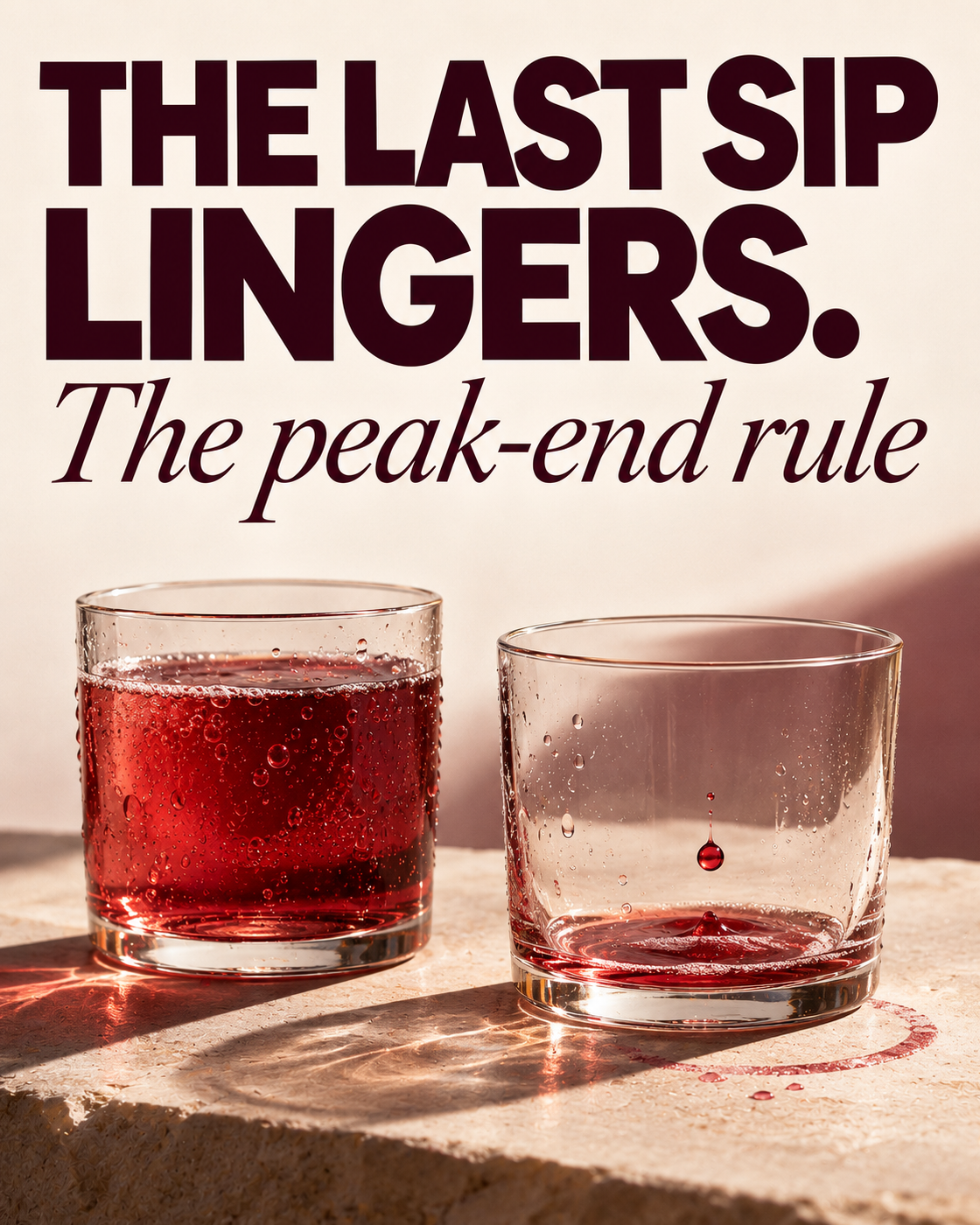
The peak-end rule describes a pattern in some retrospective judgments: people place unusual weight on an episode's most intense moment and its ending. Those memorable moments may influence the overall evaluation more than a time-weighted record of the full episode would predict.
In 1993, Daniel Kahneman, Barbara Fredrickson, Charles Schreiber and Donald Redelmeier studied a simple but uncomfortable choice. Participants kept one hand in cold water at roughly 14°C for 60 seconds. In another trial, they endured the same initial 60 seconds and an additional 30 seconds as the water warmed slightly, remaining unpleasant.
A significant majority chose to repeat the longer experience. Its ending was somewhat less painful, even though it contained more total discomfort. This was a result of that experiment, not a claim that more pain is generally preferred.
The mechanism is about retrospective evaluation, not a rule that governs what people feel in real time. In a 1996 study of medical procedures, Donald Redelmeier and Kahneman found remembered pain was strongly associated with peak pain and pain near the end. The duration of the procedures contributed less to remembered evaluations than a simple total-pain account might suggest.
Outside CPG: the cold-water choice
Imagine choosing which of two uncomfortable tasks to repeat. If you compare only how long you suffered, the 60-second option is better. But if your memory gives extra weight to the last few seconds, the 90-second option can feel like the easier one to repeat.
That example comes from an actual laboratory study. We should not assume the same weighting appears in every context. A 2008 study reported peak-end effects for some pleasurable material-goods experiences. But a 2019 set of three experiments involving children and adults failed to find the predicted effect for simple positive experiences. The evidence has boundaries.
A beverage decision
Consider two hypothetical citrus formulas. Version A tastes exciting at first but leaves a sharp aftertaste. Version B makes a quieter entrance but finishes cleaner. We do not know which one would be preferred, remembered, or repurchased.
The useful commercial question is whether the evaluation changes across moments. Before approving a major production run, I would test blind first impressions, ratings across the drinking experience, aftertaste and finish, and a delayed overall assessment. Then, where practical, compare those results with actual repeat behavior rather than treating stated intent as a sale.
Packaging matters for discovery and expectations. It cannot guarantee how the liquid will be experienced. Equally, a pleasant ending alone cannot rescue an unsafe, poor-quality or overpriced product.
Challenge the assumption
Assumption to test: The remembered experience is just the average of every moment.
Sometimes it is not. But the counterargument matters: the peak-end pattern is not a universal formula. Context, timing, attention, duration and the kind of experience can affect what people remember. No beverage purchasing effect follows automatically from a cold-water experiment.
Your mental operator
Use Experience versus memory. First measure what happens moment by moment. Then measure what the same person reports after the experience ends. Ask where those two records disagree and whether the disagreement predicts a consequential decision.
Reasoning exercise: decide before reading
Illustrative numbers, not study data. Five moments are scored from 0 to 10 for enjoyment. Experience A: 7, 7, 7, 7, 7. Experience B: 3, 3, 3, 9, 9. Which has the higher moment-by-moment average? If someone used only the best moment and the ending as a simple memory shortcut, which would they rate higher?
Worked answer
A's average is 7. B's average is (3+3+3+9+9)/5 = 5.4. A wins on average enjoyment. But the illustrative peak-end shortcut gives A (7+7)/2 = 7 and B (9+9)/2 = 9. That shortcut would favor B. This is a teaching device, not a validated scoring equation or a guaranteed human response.
Keep this: An experience is what happened. A memory is what remains. Test both before deciding what people will want to repeat.
Research
- Kahneman, Fredrickson, Schreiber and Redelmeier (1993), When More Pain Is Preferred to Less
- Redelmeier and Kahneman (1996), real-time and remembered pain in medical procedures
- Do, Rupert and Wolford (2008), pleasurable experiences
- Mah and Bernstein (2019), a boundary-condition replication
Research sources and notes
Verified from original journal, PubMed indexing/abstracts and APA DOI abstract on November 7, 2026. These primary academic sources support the mechanism and its limitations. Beverage applications and numerical exercise are explicitly hypothetical.
Kahneman, D., Fredrickson, B. L., Schreiber, C. A., & Redelmeier, D. A. (1993). When more pain is preferred to less: Adding a better end. Psychological Science, 4(6), 401–405. https://www.psychologicalscience.org/journals/psychological-science/j.1467-9280.1993.tb00589.x/
- Under controlled cold-water immersion, more unpleasant time followed by a somewhat better ending was often preferred on repetition. Pain persisted in the warmer segment.
Redelmeier, D. A., & Kahneman, D. (1996). Patients' memories of painful medical treatments: Real-time and retrospective evaluations of two minimally invasive procedures. Pain, 66(1), 3–8. https://pubmed.ncbi.nlm.nih.gov/8857625/
- Observational retrospective pain evaluations associated with remembered peak and final pain, not proof that duration never matters.
Do, A. M., Rupert, A. V., & Wolford, G. (2008). Evaluations of pleasurable experiences: The peak-end rule. Psychonomic Bulletin & Review, 15, 96–98. https://pubmed.ncbi.nlm.nih.gov/18605486/
- Evidence in some pleasurable material-goods experimental settings, not a demonstration of beverage repurchase.
Mah, E. Y., & Bernstein, D. M. (2019). No peak-end rule for simple positive experiences observed in children and adults. Journal of Applied Research in Memory and Cognition, 8(3), 337–346. https://doi.org/10.1037/h0101838
- A three-experiment replication involving N=988 reported no predicted effect for several simple positive experiences, establishing boundary conditions.
Educational editorial content. Hypothetical examples are labeled in the original edition.