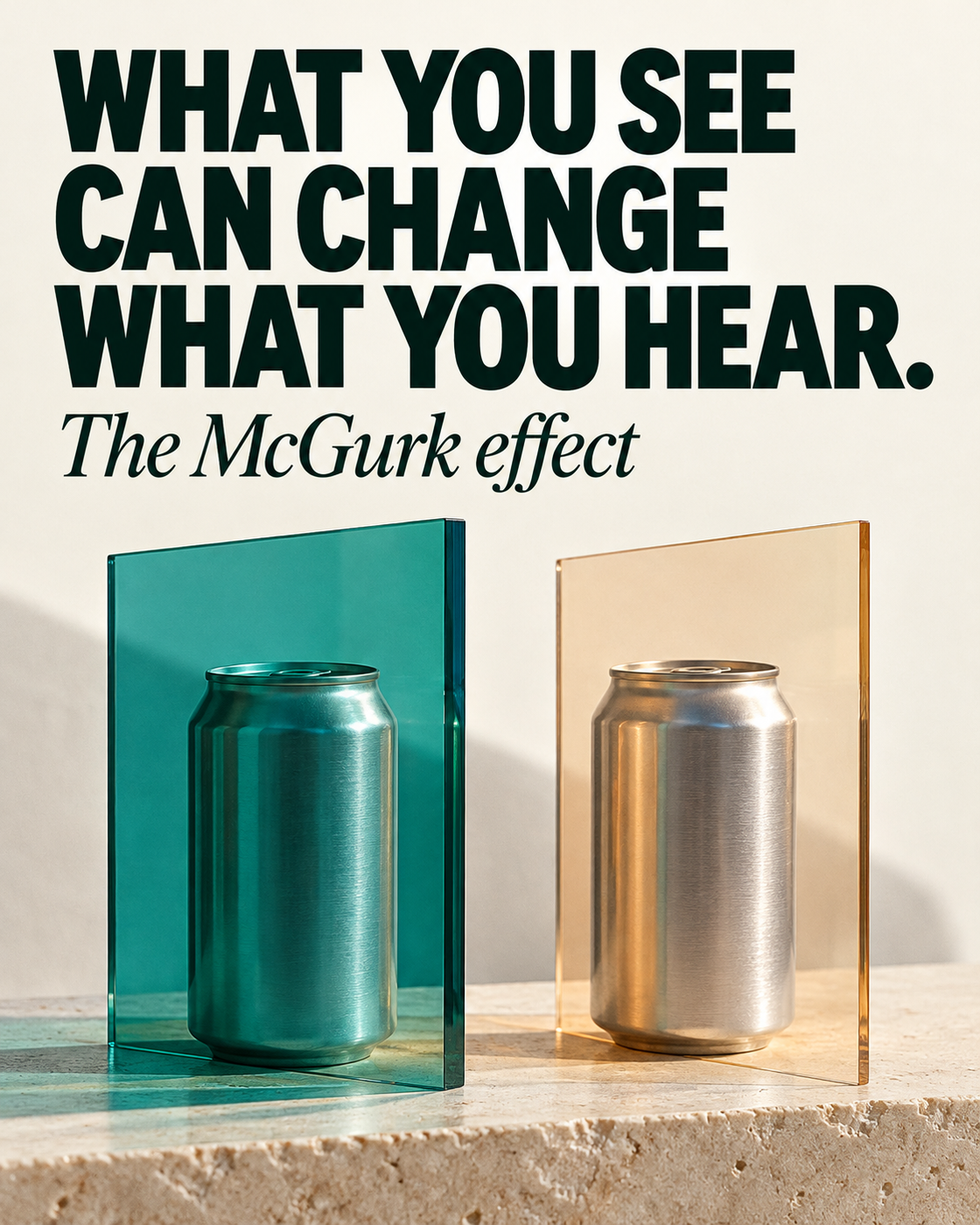
You can hear a sound that was never played.
In 1976, psychologists Harry McGurk and John MacDonald showed people a video of someone forming one speech sound while a different sound played through the speakers. In a key example, the soundtrack repeated “ba” while the lips appeared to say “ga.” Some adults reported hearing “da.” When the auditory track was presented without the mismatched mouth movements, people identified the spoken sound accurately.
That surprising result became known as the McGurk effect.
1. The mechanism
Your brain must estimate what happened in the world from incomplete signals. In ordinary conversation, mouth movements and sounds usually come from the same speaker. Visual information can therefore help interpret noisy speech.
But when the cues conflict, combining them can produce a percept that matches neither the soundtrack nor the visible articulation exactly. The soundtrack has not changed. The person's reported hearing has.
This isn't mind control or an optical trick that works on everyone. Responses vary dramatically with the video, audio clarity, timing, the task, and the observer. Later research found large differences between people looking at the very same stimuli. The McGurk illusion also isn't a complete test of someone's everyday ability to understand speech with visual help.
2. Outside CPG: A noisy conversation
Imagine trying to understand a friend in a crowded café. Watching their mouth can help you catch a word that the noise partly masks. That is useful multisensory integration.
Now imagine a badly dubbed film, where the mouth moves differently from the spoken audio. Under certain conditions, your impression of the syllable itself may shift. This is a hypothetical illustration of the same general principle, not a claim that any particular dubbed scene will trigger the original illusion.
The important distinction is that perception is constructed using multiple available cues. It isn't always a clean report from one sense organ.
3. What this does, and doesn't, mean for beverages
Here is the useful connection, and its limit.
The McGurk experiment concerns audiovisual speech, not flavor. It does not establish that changing a can changes how its contents taste.
There is, however, a separate research literature on food and beverage perception. Reviews by Oxford researcher Charles Spence and colleagues show that color, packaging, labels, and other contextual cues can influence flavor expectations and, in some circumstances, reported tasting experiences. Effects depend on the cue, product, task, and consumer. An expectation can also backfire if the drink fails to deliver what the visual presentation suggests.
Consider a hypothetical citrus beverage presented in two can designs: cool teal and warm peach. The liquid, temperature, serving size, and ingredients are identical. If descriptions differ, that difference might reflect expectations from the packaging, a change in experienced flavor, random variation, or several of these together.
It would be a mistake to jump directly from that observation to “the formulation tastes sweeter.”
For a commercial decision, separate three tests: evaluate the liquid blind, measure expectations from the design before tasting, and evaluate the complete package-and-product experience. If possible, randomize conditions and test whether the results persist. Shelf findability and purchase behavior need their own evidence.
4. Assumption and counterargument
Assumption to challenge: “A taste score measures only what's in the can.”
Not necessarily. Context may shape the response.
Counterargument: A blind taste test strips away the context in which people actually buy and enjoy a drink. A product can perform differently in real life without anyone being mistaken. That's why removing packaging effects is useful for diagnosis, but not sufficient for predicting market success.
5. Mental operator
When a judgment surprises you, separate the physical stimulus, the cues surrounding it, and the reported experience. Then ask which one your evidence actually measured.
6. Reasoning exercise
In a hypothetical test, 40 people see a teal can and 40 see a peach can. Both groups receive exactly the same beverage. Before tasting, expected sweetness averages 3.8/10 for teal and 5.6/10 for peach. After tasting, reported sweetness averages 4.6/10 and 4.9/10, respectively.
Before reading the answer: Which difference is larger? Have we proved that the package changes perceived sweetness? What would you test next?
Worked answer: The difference in expected sweetness is 1.8 points. The difference in reported sweetness after tasting is 0.3 points. Those descriptive differences don't establish a repeatable causal effect on taste without checking assignment, variation, and uncertainty. They say nothing about a chemical difference, because the drink is identical. Next, compare randomized branded and blind tastings, keeping serving conditions consistent, and check whether the apparent effects repeat.
Takeaway: What you perceive is often shaped by more than the thing you believe you're measuring.
Research sources and notes
Verified sources
- McGurk & MacDonald (1976), Hearing lips and seeing voices, Nature: Original experimental demonstration; audio ba with visual ga may produce perceived da
- Audiovisual speech perception: Moving beyond McGurk (2023), review: Variation across people/stimuli; limitations of McGurk as index of everyday audiovisual speech perception
- Spence (2015), On the psychological impact of food colour: Evidence and boundary conditions on color, expectations, flavor reports and mismatch
- Piqueras-Fiszman & Spence (2015), Sensory expectations based on product-extrinsic food cues: Review of packaging, labeling and other external cues affecting expectations in food and beverage perception
Educational editorial content. Hypothetical examples are labeled in the original edition.